What Is the Spiritual Heart?
In 2018, I had a profound experience I couldn’t explain.
During a spontaneous healing/kundalini experience, my ordinary sense of being a solid physical body suddenly changed.
The boundary between myself and the space around me seemed to disappear. I didn’t just feel connected to the space around me—I felt one with it. It was as though my body itself had become space.
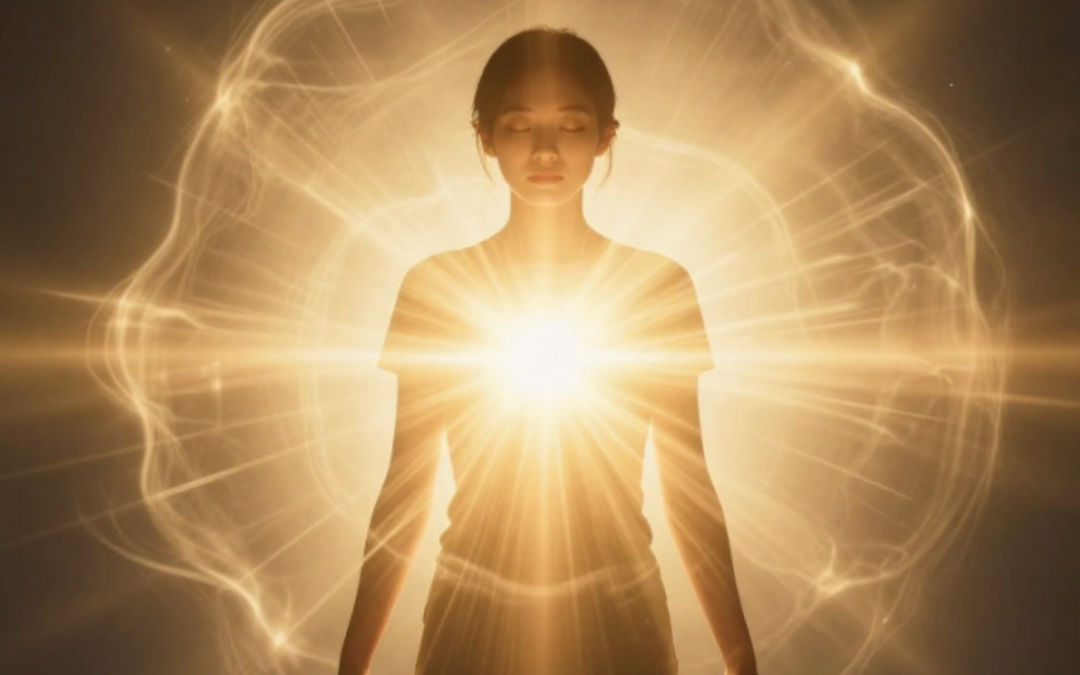
Moments later, I felt what I can only describe as a rush of liquid, electric energy shoot out from the center of my chest.
Instantaneously, my body felt as though it were made of light.
In the days and months that followed, something else continued.
I would feel this extraordinary, blissful energy radiating from my chest.
And the world itself seemed different. Everything felt alive. Things seemed to bounce and breathe. I felt as though I were immersed in an ocean of energy rather than moving through a world of solid objects separated by empty space. My body felt especially light and spacious.
That night, even the space around me didn’t look empty. It seemed filled with movement, almost like the shimmering distortion you see when heat rises from asphalt on a hot day. What I normally perceived as empty space appeared dynamic and alive.
In the days and weeks that followed, that particular perception changed, but I continued to notice a kind of luminescent quality in the space around me, as though there were a subtle light present that I hadn’t noticed before. Eventually, that too faded and my ordinary perception returned. The sense that the universe was alive faded too, although, interestingly, both would eventually return—and become a continuous part of my experience. I’ll come back to why I think that happened later.
I had already been studying the ancient Science of Consciousness, Vedānta, and questioning the nature of physical reality. I was asking what it really meant to be Awareness, and how the apparently solid world we experience could actually be an appearance within Consciousness.
But now those questions were no longer merely intellectual. I had experienced reality differently.
And I had new questions.
What was this energy I had felt coming from my Heart?
Why had the boundary between “me” and the space around me disappeared?
Why had my body felt as though it were made of light—and how had it healed?
Why had my perception of the physical world changed so dramatically?
And the question I had already been asking became even more pressing:
How does Consciousness create the appearance of a physical reality that seems so solid and separate?
The Experience Changed What “Reality” Meant to Me
I already understood the Vedāntic teaching intellectually: Awareness—Being itself—is the only thing that is ultimately Real because it is unchanging, ever-present and unlimited. Everything else—thoughts, emotions, the body and the physical world—is apparently real. It appears, we experience it, but it comes and goes.
Like a dream.
And that’s an important distinction. Vedānta isn’t saying the world doesn’t exist. A dream exists while you’re experiencing it too. It can feel completely real. But when you wake up, you realize it wasn’t what you thought it was.
That’s how I had understood Māyā: the power through which one, non-dual Reality appears as a universe of separate people, objects, bodies, space and time.
Another way to understand Māyā is to imagine a movie appearing on a screen. On the screen we see people, trees, buildings, oceans—and a character we experience as “me.” Everything appears to be separate.
But everything in the movie is made of the same light. The light appears as the character, the tree, the ocean and the entire world without ever actually dividing itself into separate things.
And the screen isn’t really separate from the light either. In this analogy, Awareness is both the light and that within which the entire experience appears.
The ego arises when Awareness identifies with one particular image and says, “That’s me.”
This is Māyā: the One appearing as many without ever actually becoming many.
The world isn’t nothing. It simply isn’t what it appears to be.
But until my experience, I only had an intellectual understanding of this.
Now, for the first time, I felt as though I had experienced what Vedānta was pointing to.
The solidity of my body seemed to disappear. The boundary between my body and the surrounding space disappeared with it. And moments later, my body appeared and felt as though it were made of light.
What had always seemed unquestionably solid suddenly didn’t seem solid at all.
What I normally experienced as “me” and what I normally experienced as “the world” seemed to become increasingly spacious and almost etheric.
It was literally as if I were waking up from a dream.
In a dream, there is a world, and there is a dream version of you apparently moving through that world. When you awaken, both disappear together.
That’s what this felt like. The subject—me, the person I thought I was—and the objects I experienced as “the world” seemed to be dissolving together.
And yet, strangely, I was still there.
For the first time, I began to understand something Vedānta had been telling me all along:
Consciousness wasn’t something contained inside the person experiencing the world. The person and the world were both appearing within Consciousness.
And suddenly Māyā stopped being an abstract spiritual concept for me.
But my experience left me with an enormous question:
How?
How does this happen?
How does the one appear as many?
How does the unmanifest appear as space, time and matter?
How does Consciousness appear as both the observer and the observed?
What is the mechanism of Māyā?
I didn’t have an answer.
And I wouldn’t find the whole answer at once. Instead, I began finding pieces.
The first came not from physics, but from something I had never heard of before:
the Spiritual Heart.
Discovering the Spiritual Heart
It was through the work of Lincoln Gergar that I first encountered the concept of the Spiritual Heart. This was not something I had known about before my experience. I hadn’t been trying to open or awaken my Heart. My Vedanta teacher hadn’t really emphasized the importance of it like some other nondual teachers do.
The experience of the Heart, for me, came first. The explanation came later. This has become something of a theme in my life.
Lincoln taught a meditation practice of bringing awareness into the Heart. Specifically the right side and back toward the spine. I was immediately intrigued because of the energy I had already been experiencing radiating from my chest.
As I began intentionally bringing my attention there, I noticed something remarkable.
My mind became quiet. My emotions calmed. My body relaxed.
And the Heart itself began to feel like empty space—a vast, vacuous space.
Beneath the constant thinking was an extraordinary sense of peace and presence. And the more time I spent there, peace turned into bliss and the more I began to recognize something I can only describe as the “I AM” state.
Not I am Kat. Not I am this body. Not even I am a person.
Simply:
I AM.
An impersonal sense of existence itself.
Before we can say:
I am a woman.
I am a scientist.
I am successful.
I am afraid.
I am not good enough.
something much more fundamental must already be true:
I AM.
You exist before you describe yourself.
Being can be difficult to understand intellectually because most of us automatically equate “I exist” with “I am this person in this body.”
Deep sleep offers a simple way to begin to understand the distinction. In deep, dreamless sleep, there is no ordinary sense of “me.” There is no awareness of your name, your history, your body, your problems or even the world around you. The entire reference frame through which you ordinarily experience yourself as this particular person is absent.
And yet, you don’t cease to exist.
What disappears is not Being. What disappears is the experience of being “me.”
The difference is that in deep sleep, we aren’t consciously aware of this absence of “me” while it is happening. In the Spiritual Heart, the usual sense of being a separate “me” can become quiet, yet you remain aware of your own presence—your own Beingness. You know that you are, without needing to define what you are.
There is simply I AM—the direct experience of existing before we add: I am this body. I am this person. This is my story.
And something else began happening. In the quiet of the Heart, insights seemed to arise without my thinking my way toward them. I began to intuitively understand more about what I had experienced that night in 2018—particularly the relationship between Consciousness, the underlying field, and the material world I had always assumed was objectively “out there.”
Going into the Heart didn’t simply change how I felt. It seemed to change what I was able to perceive and understand about myself and material reality.
It began to feel as though the blissful energy I was experiencing wasn’t simply energy. It felt intelligent—like Mind itself. Over time, I began to understand it as Universal Mind and to question whether what I had always considered my individual mind was ever truly separate from it.
A dream offers a simple analogy. While dreaming, you believe you are the character inside the dream. But when you wake up, you realize that you weren’t merely the character—you were the mind in which both the character and the entire dream world appeared.
You never really were the dream-self.
This gave me a new way to understand what had happened to me that night in 2018.
That night, my state of being had changed dramatically. I felt open, weightless, at one with my surroundings—and the reality I was capable of perceiving seemed to change with it.
The material objects and even the space around me seemed to take on those same qualities I was feeling internally. Matter no longer appeared completely solid. It seemed almost as though it were made of light floating in space.
That realization would eventually lead me to a much bigger question:
If the world really existed independently “out there,” why did changing my state of being seem to change the reality I was capable of perceiving?
Looking to Physics for an Explanation
After spending a few years exploring the Spiritual Heart through my own experience, I wanted to know whether physics, or any other field of science, had anything to say about what I was experiencing.
Vedānta had given me one framework: Consciousness is fundamental, and what we experience as the material world is an appearance within it.
My experience had made that idea feel startlingly real.
And the Spiritual Heart had given me an experiential sense of a quiet, spacious level of Being beneath thought, identity and form.
But I still wanted to understand the mechanism of Māyā.
How could Consciousness appear as a physical world?
So I began looking to physics.
I discovered that some physicists had gone much further in questioning the fundamental nature of matter than I had ever imagined. Sir James Jeans (1877–1946) famously wrote that “the Universe begins to look more like a great thought than like a great machine.” Decades later, Johns Hopkins physicist Richard Conn Henry argued in a 2005 Nature essay titled The Mental Universe for an immaterial, mental conception of reality.
These interpretations fascinated me because they echoed something Vedānta had been teaching all along—and something my own experience had made increasingly difficult for me to dismiss:
What if Consciousness is fundamental and matter is the appearance—not the foundation—of Reality?
At first, much of the physics felt completely over my head, and more than once I wondered whether I really needed to understand any of it. But something kept drawing me back. I listened and relistened until the language became familiar, and gradually, ideas that had once seemed inaccessible began to make sense.
But I was still left with the same question:
How?
How does Mind become matter?
How does an underlying Field organize into the apparently solid, three-dimensional world we experience?
Physics, at its most basic level, is an attempt to describe the nature and behavior of physical reality. But if Vedānta is right that what we experience as the physical world is an appearance within Consciousness, then in a sense, physics is studying the structure of the dream.
Think again about a nighttime dream. A scientist within the dream could study its objects, measure distances, observe patterns and discover consistent relationships between events. Those discoveries could accurately describe how the dream world behaves—without necessarily revealing that the entire world being studied is appearing within Mind.
This became an important distinction for me. I wasn’t looking to physics to tell me whether Consciousness exists. I wanted to know whether physics could help me understand how the appearance we call physical reality is structured—and how Mind could appear as this.
From the Field to Matter
That search eventually led me to the work of Nassim Haramein.
When I encountered his model of the double torus, something clicked.
Fig 1. Haramein’s animation shows the double torus in motion and then from above, where the familiar yin-yang pattern emerges from the dynamics of the flow. [Watch the animation beginning at about 1:00:00 → Here]
Before going further, I should clarify what I mean when I use the word Field. I don’t mean simply a field of energy. I think of it as something closer to Mind—information and intelligence with the capacity to organize into form.
A dream gives us a simple way to imagine this. Every night, our minds create an entire world within our awareness—people, places, objects and even a body that feels like “me.” The mind doesn’t build that world from something separate from itself. It organizes information into an experience that appears as form.
So when I use the word Field, don’t think of something outside of you. Think of it as the underlying fabric of Mind—the “space” within Mind from which experience and form can arise.
This was the question I was trying to understand about physical reality:
Could something similar be happening here? How does the Field organize into matter—and ultimately into the physical reality we experience?
In Haramein’s model, the quantum vacuum, the Field, has an incredibly fine structure composed of tiny Planck-scale units of energy he calls Planck Spherical Units, or PSUs, after physicist Max Planck. You can imagine them almost like three-dimensional pixels of light, or voxels.
Think about an image on a screen. From a normal distance, you see people, trees and buildings. Magnify the image enough, however, and those objects resolve into tiny pixels. The person was never separate from the pixels—the pixels were simply organized into the image of a person.
And this pattern isn’t limited to the human Heart. In the model I was beginning to understand, the same basic organization repeats at different scales. The singularity is the center of the toroidal flow—the point around which the pattern we experience as form becomes organized.
That gave me a completely different way to think about the objects around me. A person, a cell, an atom or any apparently separate form may not be something sitting in the Field. Each can be thought of as a localized expression of the Field, organized around its own center within a much larger nested system. (Fig. 2.)
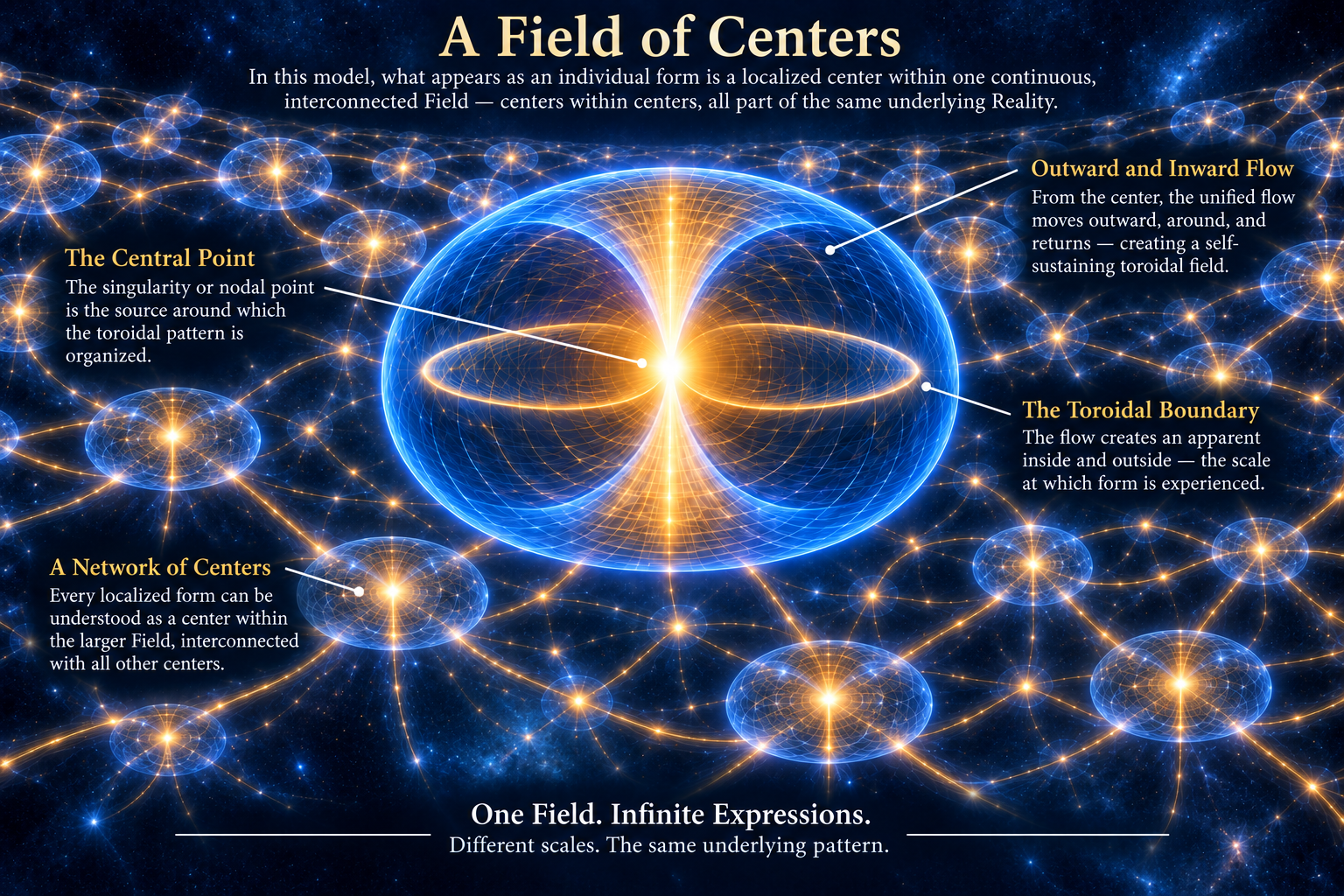
A conceptual visualization of localized centers within one continuous, interconnected Field.
Or imagine a whirlpool in the ocean. It appears to be a distinct thing, with a recognizable shape and center, but there is no separate substance called “whirlpool.”
It is the ocean organizing itself into a pattern of motion.

Fig. 3. A whirlpool is not separate from the ocean—it is the ocean organized into a localized pattern of motion.
This is where the double torus really came alive for me. It isn’t a static structure. It is continuously spinning and circulating, with energy flowing outward from the center, around the structure and back toward the center again. In Haramein’s model, the singularity at the center is fundamental to this continuous, self-sustaining flow.
If you’d like to see Haramein’s model explained visually, I recommend this conversation between Nassim Haramein and Foster Gamble: Unified Field Theory Solved?
What intrigued me was that this wasn’t simply circulation. It was a feedback and feed-forward dynamic—information continually returning through the system and informing what emerges next. In that sense, the double torus began to look remarkably like Mind to me: a dynamic process continually referencing and informing itself.
And perhaps this is one reason the Field is so difficult to understand conceptually: we are trying to use the mind—a self-referencing process—to understand what is prior to self-reference itself.
Haramein also showed something you might find fascinating. When these dynamics are viewed from above, the circulating flow forms the familiar yin-yang pattern. What we usually think of as a symbol of two opposing forces can also be seen, in his model, as two complementary movements within one continuously flowing system. (Fig 1. Video)
This brought me right back to something Vedānta had taught me about Māyā: the One doesn’t actually become two. It appears as two. The apparent opposites are still movements within the same underlying whole.
And that brought me back to the question I had been asking since my experience.
What if matter is the Field—Mind—organized into form?
The double torus gave me a way to visualize how information within the Field might organize and express itself as physical form.
Years Later, I Found Something Unexpected
The double torus gave me a possible way to understand how the Field could organize into physical form. But there was still another piece of my original experience I couldn’t ignore:
Why had that extraordinary rush of energy come from the center of my chest?
And why, when I later learned to bring my awareness into the Spiritual Heart, did that same region seem to lead me into such profound bliss and the experience of simply I AM?
As I continued exploring the Spiritual Heart, I began encountering descriptions that sounded remarkably similar to what I had already experienced.
In Ecclesiastes I found this curious line:
“The heart of the wise inclines to the right, but the heart of the fool to the left.”
— Ecclesiastes 10:2
When I googled this verse I realized that this Biblical passage is generally interpreted symbolically, not literally. But because of what I had already experienced, I couldn’t help wondering whether there might be another layer to it.
It immediately made me think of another Biblical idea: having “eyes to see” and “ears to hear.” Sometimes we can read the same words over and over and completely miss what they are pointing to because we haven’t yet had the experience that gives those words meaning.
If I had never experienced the profound bliss and stillness of the Spiritual Heart for myself, I probably would have read right past that verse too. Of course I would have assumed it was purely symbolic. I wouldn’t have known there was anything else to notice.
And then I discovered the great Indian sage, Ramana Maharshi.
Ramana also associated the Spiritual Heart, or Hridayam, with the right side of the chest—while making clear that the Self itself isn’t confined to a physical location.
But it wasn’t simply the location that fascinated me.
Ramana described the Heart as the source from which the sense of “I” arises.
This was something I had already experienced for myself, long before I knew Ramana had described it.
When I brought my awareness deeply into the Heart, the personal identities attached to “I” seemed to fall away:
I am Kat. I am this body. I am this history. I am this person.
What remained was simply:
I AM.
Not the personal “I” attached to a name, body or history, but the simple, impersonal sense of Being beneath those identities. The deeper I went into the Heart, the less there seemed to be a separate “me” at all.
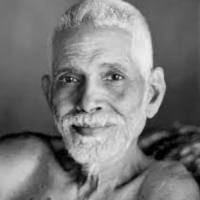
Fig. 4. “Here lies the Heart, the dynamic, spiritual Heart. It is called Hridaya and is located on the right side of the chest and is clearly visible to the inner eye of an adept on the spiritual path. Through meditation you can learn to find the Self in the cave of this Heart.”
The Singularity in the Heart
And then, much later, I heard something that made another piece of the puzzle fall into place.
During a Resonance Science Foundation Q&A, biophysicist William Brown was talking about the singularity at the center of the double torus.
He described a singularity in a way I had never heard before: as a point where all coordinates in space and time converge. He called it “oneness” and “the meeting place of all space-time points.”
Watch William Brown discuss the singularity here.
Think again about a dream. Within the dream there can be an entire world—with distance, movement, people, places and even a sense of time passing. Yet all of that space and time is appearing within the consciousness of the dreamer.
That gave me a way to imagine what Brown was describing: a point before the differentiation of space and time, from which the experience of space and time could emerge.
If physical reality is the dream, perhaps the singularity tells us something about the architecture of the dreaming.
And it immediately reminded me of an experience I’d had years before the events of 2018.
During meditation, my ordinary sense of self disappeared completely.
There was no sense of being a person sitting in meditation. There was no body, no room, no “me” observing something happening.
There was only unbroken golden-white light.
And somehow, I was that.
But even saying I was that isn’t quite accurate, because at first there wasn’t an “I” standing apart from the light that could recognize itself as the light. There was only the light.
Then something subtle happened.
There was a recognition—almost the first flicker of I am this. And as that recognition became stronger, so did the sense of being an individual point of awareness. Very quickly, I seemed to pop out of the experience, and the familiar sense of “me” returned.
For years I had no language for what had happened.
But Brown’s description of the singularity gave me a new way to think about it. Could that experience of undivided light—with no subject, object or self-reference—have been an experience of something analogous to a singularity? And could that first moment of recognition have been the beginning of a reference point—the beginning of individuation?
What made this particularly interesting was that I had already experienced something similar, although much subtler, many times while resting deeply in the Spiritual Heart.
When I become very still in the Heart, there can be simply Being, without the usual sense of being “me.” And then I can sometimes feel the transition happen. A sense of “me” begins to emerge. It is subtle at first, almost like the appearance of a reference point, and then self-referencing begins to build around it.
I can actually feel the movement from Being into the experience of being an individual “me.”
I experienced this before I had any conceptual framework for it. Later, when I encountered Ramana Maharshi’s teaching that the Spiritual Heart is the source from which the “I-thought” arises, I was struck by how closely it seemed to correspond with what I had already been experiencing.
Later, I encountered another piece of this model through physicist Inés Urdaneta, whose work, like Brown’s, developed within the unified-physics framework I had first encountered through Nassim Haramein. In her model of a quantum of consciousness, she describes the highly coherent state near the singularity of the double torus beginning to dephase as differentiation and individuation emerge.
Watch the interview of Dr. Ines Urdaneta here.
That word—individuation—immediately caught my attention.
Here was a physics-based model describing a movement from coherence toward individuation that seemed to correlate with both what I had been experiencing in the Spiritual Heart and what Ramana had described as the arising of the “I-thought.”
I find the correspondence fascinating. Could these be different ways of describing the same fundamental transition—the point at which undifferentiated Being begins to appear as an individuated point of experience?
And then Brown said something else I wasn’t expecting to hear.
He believed there could be a singularity associated with the heart.
What struck me wasn’t that the idea felt foreign. It was almost the opposite. Ever since seeing the double torus, I had felt that its central point somehow corresponded to the center I had experienced in my own Heart. I didn’t learn this idea from Brown; hearing him describe it gave language to something I had already sensed intuitively.
Brown and his colleagues have explored the possibility that a structure in the physical heart—the sinoatrial node, or SA node—could be associated with what he calls a cardiac singularity.
Watch William Brown discuss the singularity here
The SA node sits in the right atrium and is the heart’s natural pacemaker. It initiates the electrical impulse that begins each normal heartbeat.
That immediately got my attention for another reason.
Remember, the Spiritual Heart I had learned to meditate on was experienced on the right side of the chest. And here, on the right side of the physical heart, was this tiny structure initiating the electrical activity that organizes the heartbeat.
In the simplest terms:
information comes first → physical movement follows
That fascinated me.
I had been trying to understand how Mind—or information within the Field—could organize into physical form, and here was a biological example of an electrical signal initiating and coordinating a physical event.
Brown takes the idea further. In his unified-physics model, he has explored whether a microscopic singularity associated with this region could participate in what he calls “energy information exchange.”
This was when the pieces really began to come together for me.
I had experienced the Heart as a place where the ordinary sense of being a separate “me” could disappear into Being. I could sometimes feel the sense of “me” emerge again. Ramana described the Heart as the source of the “I-thought.” Inés described differentiation and individuation emerging as coherence begins to dephase. And Brown was exploring the possibility of a singularity associated with the physical heart.
Could the Spiritual Heart represent a threshold of individuation itself—a point of profound coherence from which the experience of being an individual “I” emerges?
That would also change how I understood what happens when we go deeply into the Heart.
The deeper I went, the less solid and separate everything seemed to become. The boundaries of the body softened. The sense of being a separate “me” diminished. Awareness seemed to become increasingly expansive, and the physical world itself began to feel less fixed and solid.
Maybe this wasn’t about somehow leaving the body or expanding into a Field outside of me.
There is no Field outside of me to enter.
If physical reality itself appears within the larger Field of Mind—just as an entire dream appears within the mind that is dreaming it—then both “me” and the world I experience are already appearances within it.
Perhaps going deeply into the Spiritual Heart is therefore less like connecting to the Field and more like tracing the apparent individual back toward its source.
And perhaps that is why it can feel simultaneously like coming home to yourself and becoming infinitely expansive.
The Spiritual Heart may not be where the individual connects to something larger.
It may be where the very experience of being an individual can be traced back toward the point from which it arises.
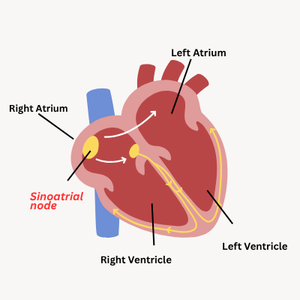 Fig. 4. The Spiritual Heart and the physical heart. Ramana Maharshi described the Spiritual Heart as being experienced on the right side of the chest—not as a physical organ, but as a doorway to the Self, the deepest level of who we are. Interestingly, the physical heart’s natural pacemaker, the sinoatrial (SA) node, is also located on the right side of the heart. This small group of cells generates the electrical activity that normally initiates every heartbeat. I don’t believe this proves that the SA node is the Spiritual Heart, but it raises an intriguing question: could the physical heart be expressing, at the level of the body, a deeper organizing principle?
The Spiritual Heart Has to Be Experienced
The Spiritual Heart isn’t something I believe we can fully understand intellectually. And simply placing your attention on your chest isn’t necessarily the same thing as entering deeply into the Heart.
There is an art to it.
For me, it involves learning to surrender—to stop trying to control the experience and allow the ordinary sense of “me” to become quiet. The constant self-referencing has to quiet too—the mind’s almost continuous habit of relating everything back to “me”: what I think, what I want, what this means for me, what happened to me, what might happen to me.
As that activity quiets, the sense of being a separate “me” begins to loosen. What remains is simply Being.
Perhaps that is why the deepest contemplative traditions don’t ultimately ask us to think our way to the nature of reality. They ask us to become still enough to experience what remains when the usual processes of thought, identification and self-reference become quiet.
You cannot think your way beyond the mind. You can only become still enough to recognize what is there before the mind begins defining it.
I experience this as allowing the light of the Heart to shine, rather than doing something to produce the light.
The deeper I go, the more the usual boundaries of self can begin to soften. Awareness becomes more expansive. The world can feel less fixed and solid. And beneath all the identities we normally attach to ourselves—I am this body, I am this history, I am this person—there is simply:
I AM.
This is different from simply generating a coherent heart rhythm or a positive emotional state. Practices such as HeartMath can be useful for learning physiological coherence, but what I’m describing here goes deeper. It is a surrender of the identification as a separate self—the idea that I am this separate, limited person—and a recognition of the deeper Field of Mind in which both “me” and the world are already appearing.
And within the model I’ve been exploring, that raises a fascinating possibility. Perhaps we aren’t imposing coherence onto the Field at all. As the identification as a separate self loosens and we come into greater resonance with the Field, we allow the deeper intelligence that is already organizing us to express itself with greater coherence.
The Spiritual Heart: The Fountain of Youth
This also gave me a way to understand another part of my 2018 experience: the spontaneous healing that occurred at the same time.
My body healed. The symptoms I associated with Hashimoto’s and a burning shoulder injury resolved instantaneously.
If the physical body is the expression of a deeper informational pattern, then perhaps healing could occur not only through changes at the level of matter, but through changes in the coherence of the information organizing it.
This was something I later discussed at length with biophysicist William Brown. In his model, the cardiac singularity is also where the informational blueprint underlying physical form can be written and restored.
I began to think of it almost like the relationship between an image on a screen and the information generating it. You can try to repair the picture one pixel at a time. But if the image is continually being generated from information beneath the picture, then changing the underlying information changes what appears on the screen.
That gave me a new way to understand what had happened to me. As my ordinary sense of being a separate person disappeared, I felt weightless and increasingly expansive, as though I were expanding into the space around me. Because I thought I might be dying, I was filled with profound gratitude for everything in my life.
Then the rush of liquid, electric energy shot from the center of my chest. Only after that did I experience my body as though it were made of light.
My perception of physical reality became less solid—and my body healed.
Perhaps those weren’t unrelated events.
If the Heart is a nodal point through which the Field organizes its expression as physical form, I began to wonder whether greater coherence might allow the body to reorganize in closer alignment with a deeper underlying pattern—what Brown calls the blueprint.
Was the Field reorganizing its own expression?
And this brings me back to the double torus.
Over time, I began calling the double torus the Fountain of Youth. Look at its movement: energy flows from the center, spirals outward and around, and returns again in a continuous circulation. In Haramein’s model, this toroidal flow is self-sustaining and self-perpetuating—the flow continuously feeds back into itself. It really does resemble a fountain.
And the body, as I have come to understand it, can be thought of as a nested system of toroidal flows, organized around the central toroidal flow of the heart—smaller patterns within larger patterns, all participating in this continuous movement of energy and information.
For me, this isn’t simply something I visualize. I can feel it.
That makes the heart’s role especially fascinating. The heart is one of the earliest organs to develop and function in the embryo, beginning its rhythmic activity very early in development. Long before the body we recognize has fully taken shape, the heart is already establishing rhythm and flow.
As I learned to rest deeply into the Spiritual Heart and surrender into both the Heart and the space around the body, I began to feel the spiral moving down and the corresponding movement rising up.
And it doesn’t feel as though I am creating it. It feels as though I am becoming aware of a flow that was already there.
This naturally raises another question: If this flow is self-sustaining and continually organizing us, why do we age or become ill?
I believe part of the answer has to do with the mind itself. We become so completely identified as separate, limited physical beings—and so absorbed in thought, belief and the material reality those processes continually reinforce—that we lose conscious awareness of the deeper Field organizing us.
The flow doesn’t stop. What may change is how coherently the physical system remains in resonance with the information moving through it.
This is a much larger subject—one that deserves its own discussion—because it brings us into the relationship between mind, belief, coherence, the nervous system and the physical body. [I explore this more deeply here]
This brings me back to what William Brown describes as the blueprint. If a deeper informational pattern underlying physical form remains available within the Field, then perhaps regeneration can be understood, at least within this model, as the physical system coming into greater coherence with the pattern continually organizing it.
Perhaps the Fountain of Youth isn’t something we need to find.
It is the continuous, self-sustaining flow through which the Field is continually creating and renewing its expression as us.
So What Is the Spiritual Heart?
After years of exploring this experientially and trying to understand it through both ancient teachings and emerging models of physics, I have come to think of the Spiritual Heart as a nodal point within the larger Field of Mind—a point of profound coherence through which undifferentiated Being becomes an individuated point of experience.
But I think it may be even more than that.
I have come to wonder whether the Spiritual Heart is the nodal point through which the dream of physical reality itself is generated.
Not generated by the individual. The individual is part of the dream. Just as a dreaming mind generates both the dream character and the world that character seems to inhabit, perhaps the larger Field of Mind expresses both the experience of “me” and the physical reality I experience through this central point.
This is important because I don’t think of the Field as something beneath us, surrounding us or existing somewhere outside of us. Physical reality appears within the Field of Mind, much as an entire dream appears within the mind that is dreaming it. The body, the other people, the objects and even the space between them all appear within that one Mind.
And this may help explain why I experience the Spiritual Heart as an access point to Being. As the identification as a separate individual becomes quiet, there can be a recognition of what we actually are—not simply the character within the dream, but the Mind in which both the character and its world are appearing.
This is what makes Ramana Maharshi’s description of the Heart as the source from which the “I-thought” arises so profound to me. The Heart isn’t simply where the individual connects to something larger. It is where the very sense of being an individual can be traced back to its source.
Could the Spiritual Heart therefore be both a threshold through which the individuated “I” emerges and a nodal point through which the physical reality it experiences is generated?
This is also why I find the physical structure of the heart so fascinating. If physical form is an expression of the information and organizing dynamics within the Field, perhaps we should expect those dynamics to be reflected in form. The muscle fibers of the physical heart are organized in complex helical and spiral patterns—strikingly reminiscent of the spiraling flow at the center of a toroidal vortex.
Perhaps that is why going deeply into the Heart can feel simultaneously like coming home to yourself and becoming infinitely expansive. The boundaries that define the separate “me” begin to soften, and we can begin to recognize that the individual we thought we were was never what we actually are.
Experience This for Yourself
Why does any of this matter? Because if we misunderstand what we are, that misunderstanding shapes the way we experience everything. If I believe I am fundamentally a separate, limited physical being moving through a world outside of me, I will experience life very differently than if I recognize myself as the deeper Mind in which both “me” and the world are appearing. The Spiritual Heart offers a way to explore that possibility not simply as an idea, but as a direct experience.
This is ultimately why I teach this material.
Understanding it intellectually is fascinating, but intellectual understanding can only take us so far. The deeper question is:
How do we awaken to this truth for ourselves?
How do we move beyond simply believing that we are more than our bodies and begin to experience the deeper Reality from which both we and the world arise?
These are the questions we explore in my 13-week introductory course:
Who are we? What is the nature of the reality we’re experiencing? How does Mind appear as matter? And how do we awaken from the experience of being a separate, limited self to what we actually are?
We explore these questions through the teachings of consciousness, physics and ancient wisdom—but importantly, we don’t stop with intellectual understanding. Through meditation and direct exploration of the Spiritual Heart, we begin to experience these ideas for ourselves.
Check Here For The Current Session